
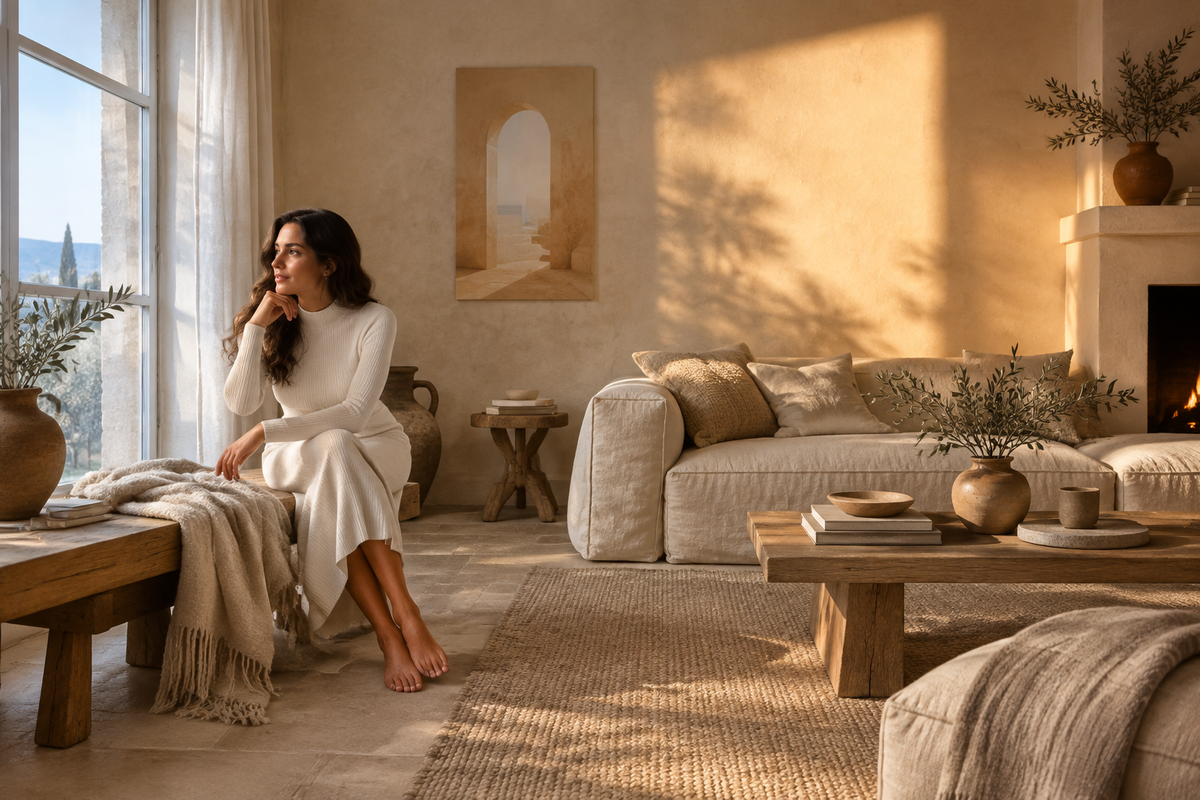
Warming a beige interior in winter: the Mediterranean method
A beige interior is beautiful in June. In November, the same room can look grey, flat, almost cold. Nothing has changed on the walls — the light has changed. The sun sits lower, the days are shorter, and the sand tones that vibrated all summer go still. Here is what you change, and above all what you don't.
Reading time: 6 min
Why a light interior cools down in winter
Beige has no colour of its own: it returns what it receives. In summer it receives a low, golden light at the end of the day, and gives it back. In winter the sun barely climbs, the light is more diffuse, often filtered through cloud — and the same wall returns that greyness.
That is why Mediterranean decorating, which comes from regions of generous light, needs adjusting at our latitudes between November and February. Not a change of style: a tuning.
The reflex to avoid: repainting everything
When a room looks dull, the temptation is to go after the walls themselves. It is long, expensive, and often regretted in spring, when the light returns and wall-to-wall terracotta becomes stifling.
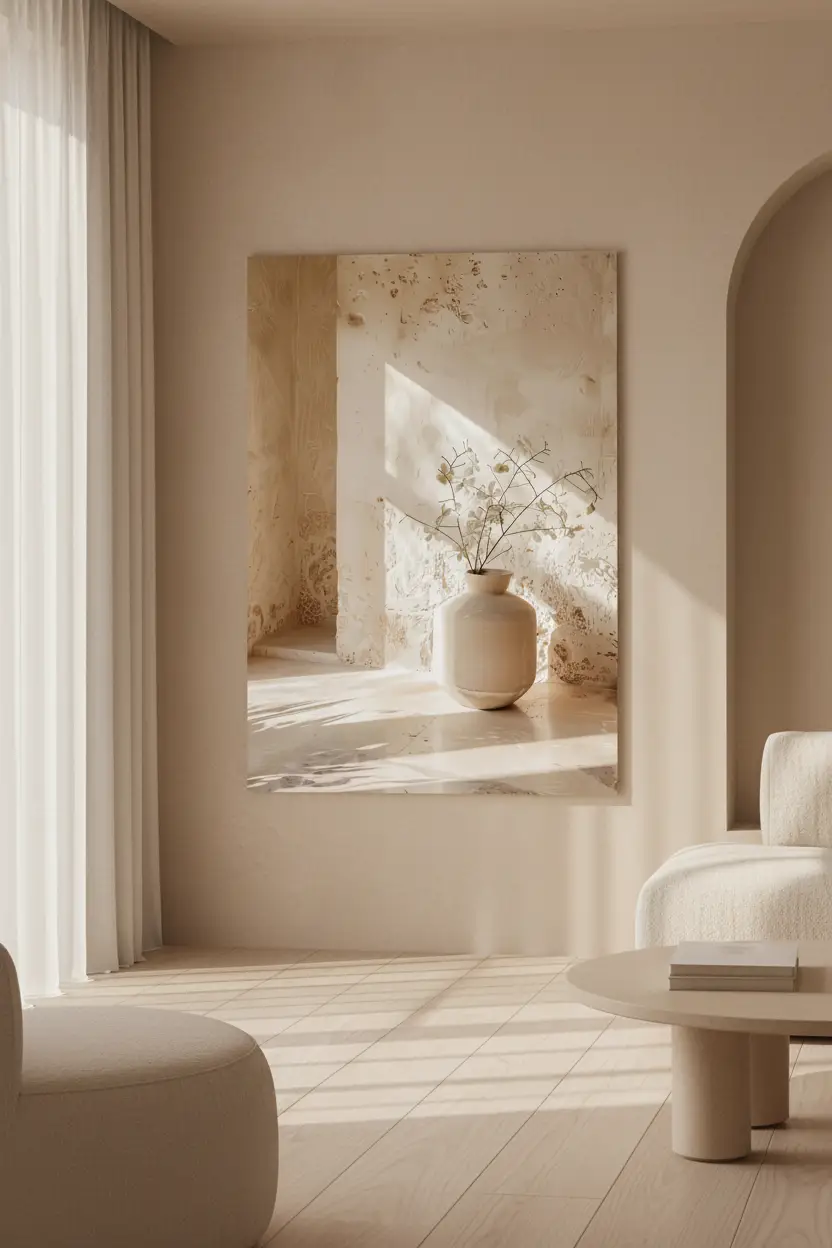
What can be changed in an hour, put back in spring, and costs about as much as a meal: what hangs on the walls. It is the only sensible seasonal lever.
From sand to terracotta: the table
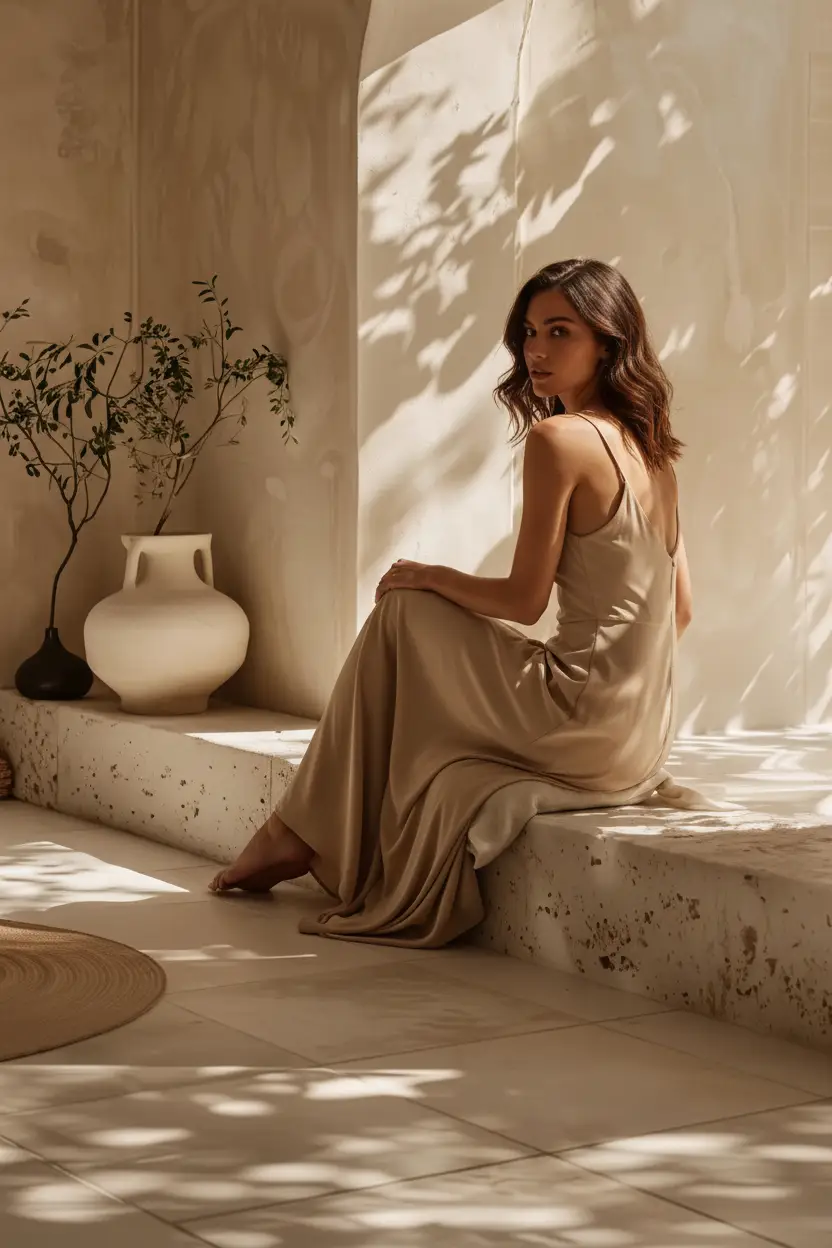
The logic is simple. In summer you look for coolness: ivory, off-white, pale stone. In winter you look for warmth: ochre, terracotta, wood, golden shadows. They are the same Mediterranean materials, caught at a different hour of the day.
| What works in summer | What takes over in winter |
|---|---|
| Pale travertine, bleached stone | Clay, terracotta, ochre plaster |
| Sea, foam, pale blue | Sunset, golden hour, peach |
| Crisp midday shadows | Long late-afternoon shadows |
| Light green foliage | Matte olive, dark foliage |

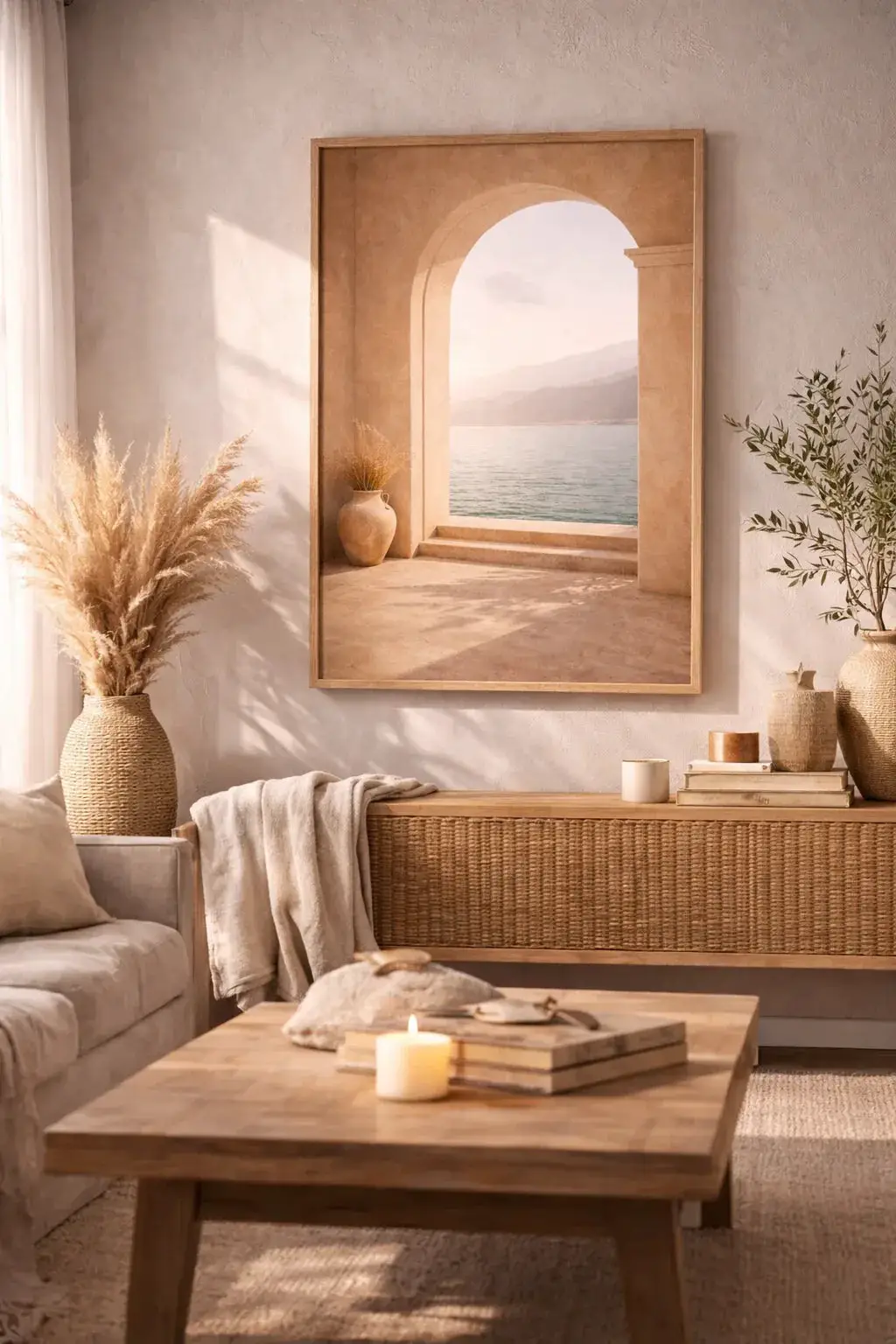
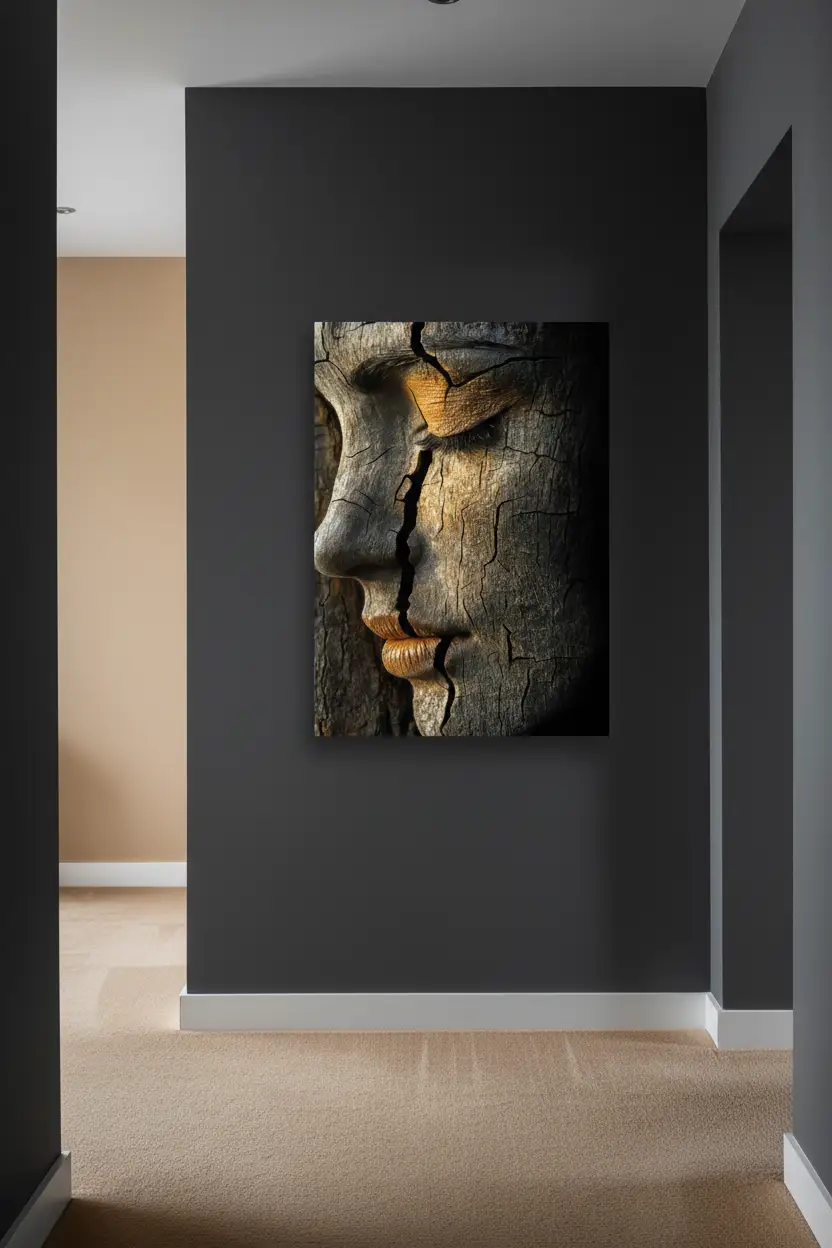
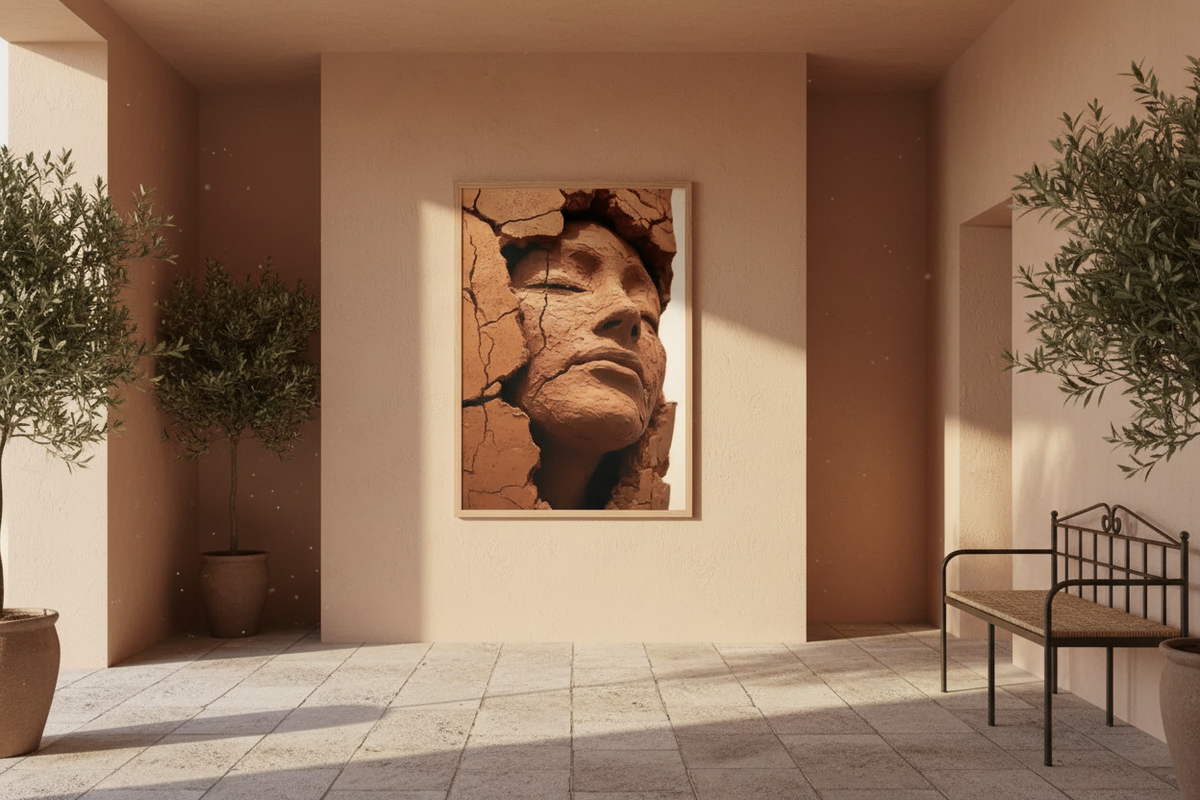
Visage d'Argile — from €39 as a poster, €89 framed
You don't need to replace everything. A single warm print in a light room is often enough to restore the balance, provided it is visible from where you sit.
→ For the colour pairings: what colour goes with terracotta and ochre, the colour of the sun.
In winter, size matters more
With less light, the eye needs firmer anchor points. A small print that held its place in summer dissolves in the half-light of five in the afternoon.
In practice: if you add a warm piece for winter, go one step above your usual instinct. A 50 × 70 cm where you would have taken a 30 × 40. The coloured surface has to be large enough to warm the room, not merely to decorate a corner of wall.
→ The full rule of proportions: what size for what wall.
The frame changes season too
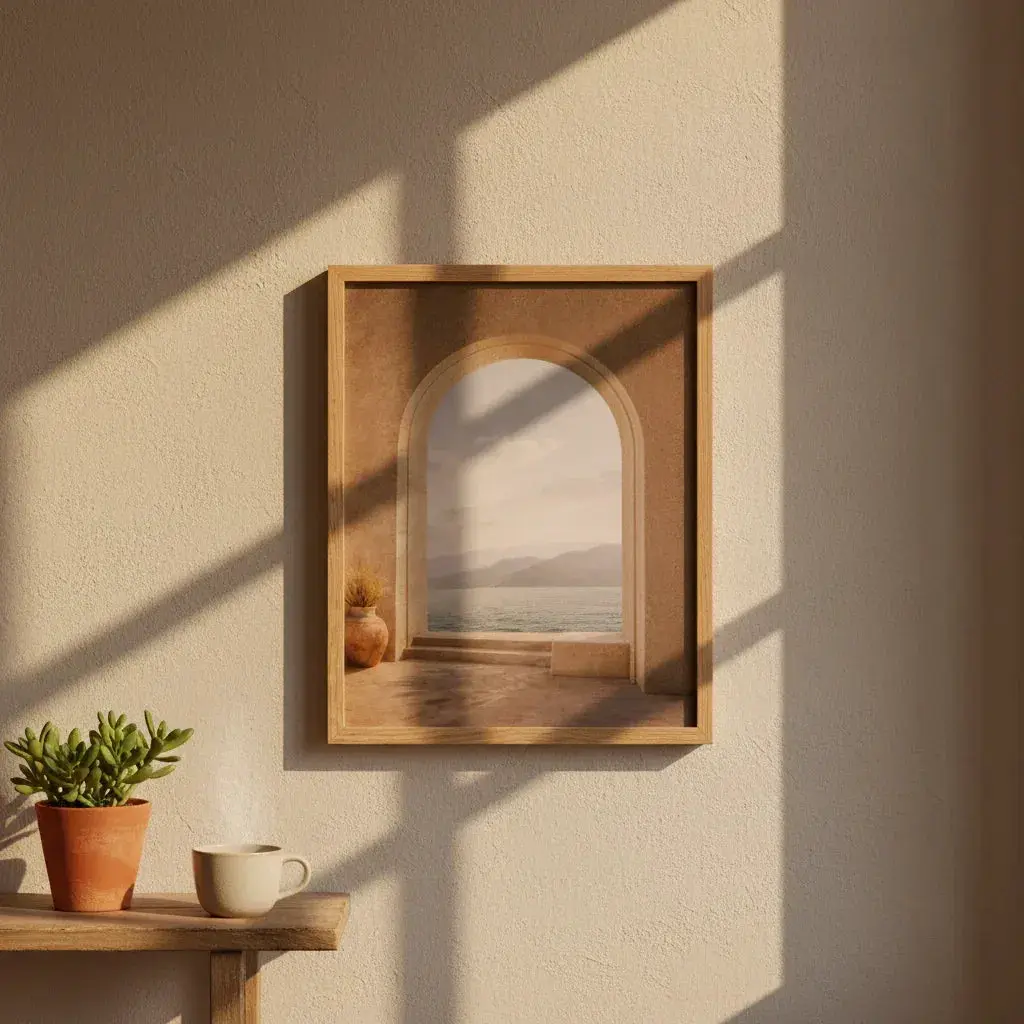
If you frame, winter favours oak. Pale wood brings a warm materiality that neither white nor black provides: white disappears into the greyness, black densifies an already dark room.
The bare poster has another advantage this season: with no glass or plexiglass, it doesn't bounce back the lamps switched on at five. In a room lit artificially for a good part of the day, that is real comfort.

The three other moves that count
Wall art doesn't do everything. Three adjustments complete it, and none of them is expensive.
Bring the light down. A single ceiling fitting flattens a room in winter. Two or three low sources — table lamp, reading light, wall light — recreate the soft shadows the sun made in summer.
Add a rough material. Jute, heavy linen, bouclé wool, unglazed ceramic. A successful winter room is touched as much as it is looked at.
Group things together. In summer you open things out. In winter you pull them in: an armchair drawn towards the window, a rug that defines, objects gathered on a side table rather than scattered.

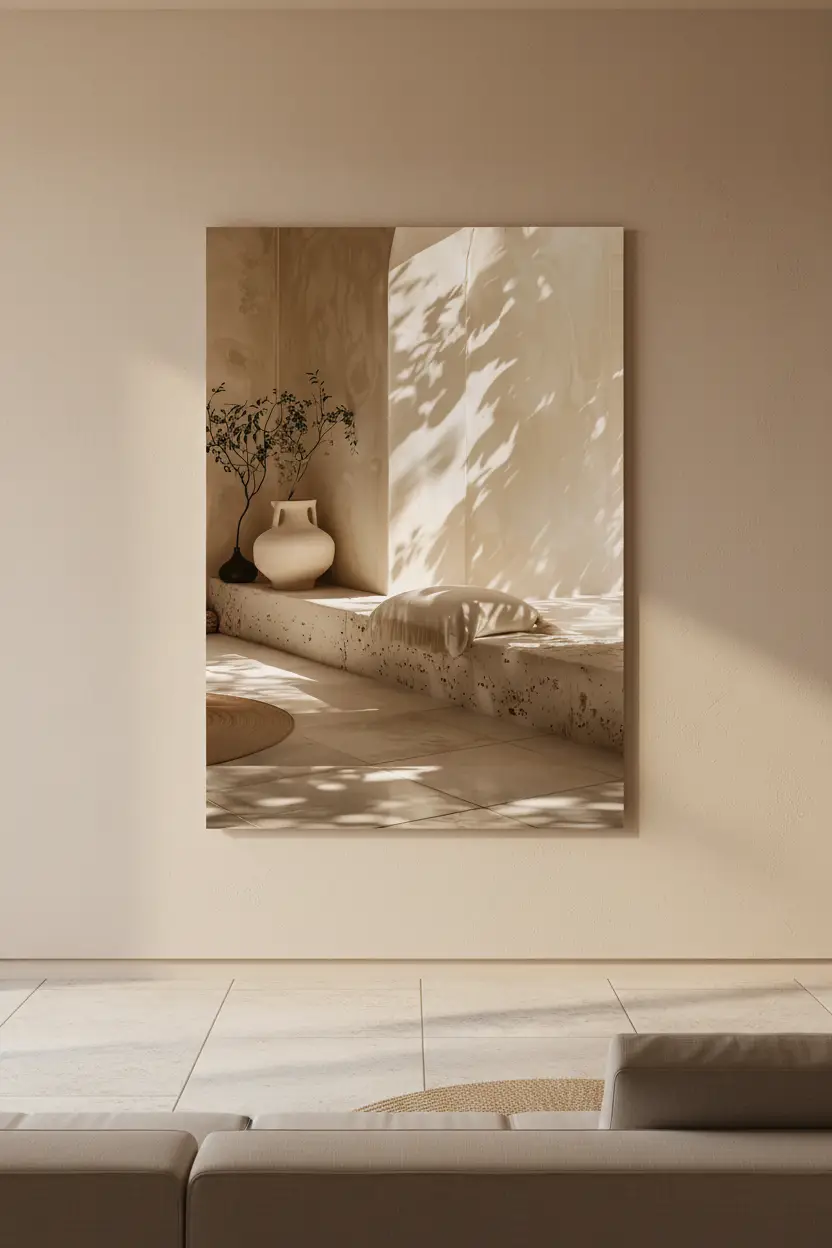
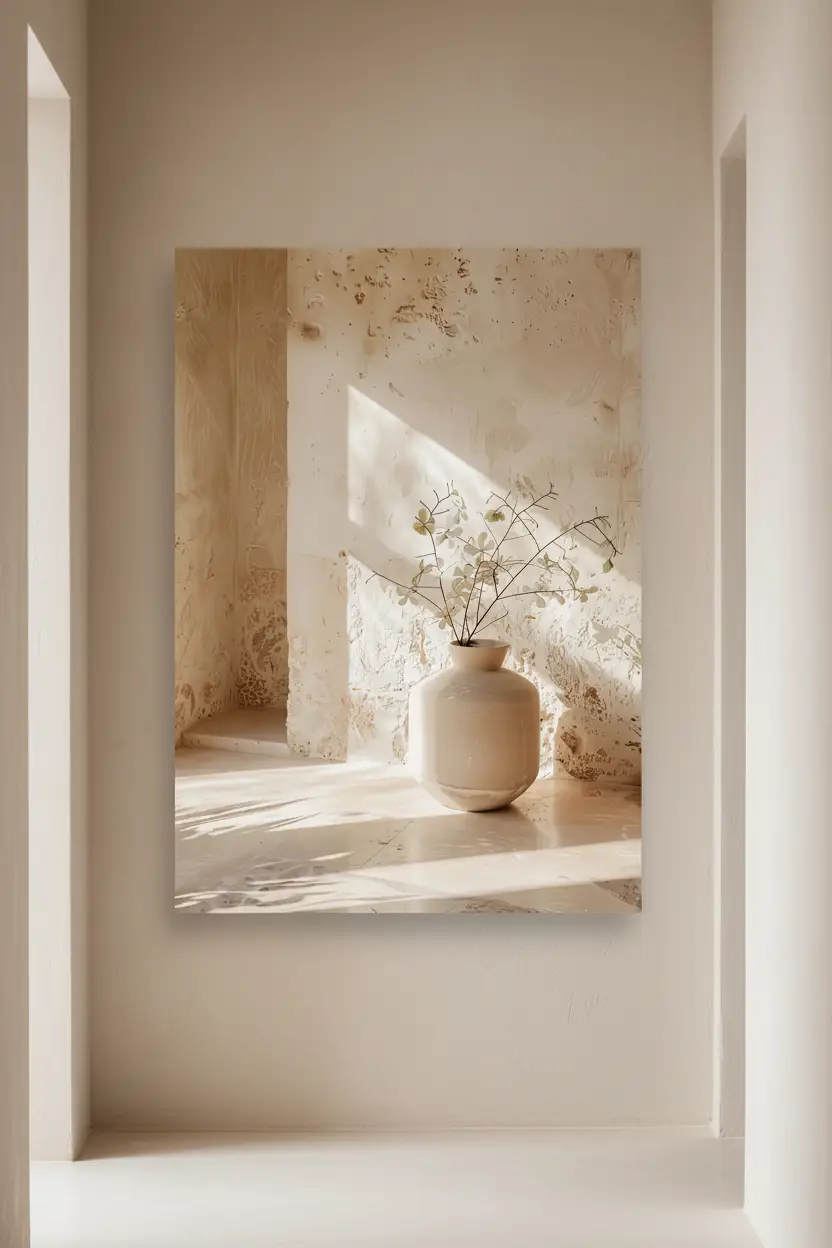
La Torsade de Calcaire — from €39
→ On materials: rattan, linen and natural fibres. On light: making the most of natural light.
Cassili-home
Three warm prints for winter — 50 × 70 cm, €59
 Âme de Terre50 × 70 cm poster · €59View the print →
 L'Ombre de Pierre50 × 70 cm poster · €59View the print →
 Le Crépuscule50 × 70 cm poster · €59View the print →
Also available in 30 × 40 cm (€39) and framed from €89.
And in spring?
You put the pale pieces back. That is the whole point of playing with the walls rather than the paint: a print comes down in two minutes. Two sets of prints, swapped twice a year, give the feeling of a rethought interior for the price of a single purchase.
Store the piece you take down flat and away from direct light, not rolled up for six months.
Mistakes to avoid
- Switching everything to terracotta — the room turns heavy. One or two warm notes in a light whole, not the other way round.
- Keeping sizes too small — in low light, a small print disappears.
- Stacking up black frames in an already dark room.
- Painting in November — a colour chosen under winter light will look saturated in May.
- Forgetting the lighting — the finest print cannot make up for a single cold ceiling fitting.
Browse the terracotta prints →
FAQ — Warming an interior in winter
Which print colours warm a room in winter?
Ochres, terracottas, golden sands and the peach tones of a sunset. They are the same Mediterranean materials as in summer, caught at a different hour: they bring warmth without breaking with a light interior.
Do you need to repaint to warm up a beige interior?
No, in most cases. A colour chosen under winter light will look saturated in spring. Changing what hangs on the walls takes an hour and can be undone when the good season returns.
What print size should you favour in winter?
One step above your usual instinct: 50 × 70 cm where you would have taken 30 × 40. In low light, a small print dissolves and no longer warms the room.
Poster or framed print in winter?
The bare poster avoids reflections from the lamps you switch on in the late afternoon. If you frame, oak brings a warm materiality that white and black do not.
Can you change your prints with the seasons?
Yes, and that is precisely the point of playing with the walls rather than the paint. Store the piece you take down flat and away from direct light, rather than rolled up for six months.
→ All our wall prints
→ Terracotta · Ochre · Shadow & Light · Travertine



Leave a comment
This site is protected by hCaptcha and the hCaptcha Privacy Policy and Terms of Service apply.