

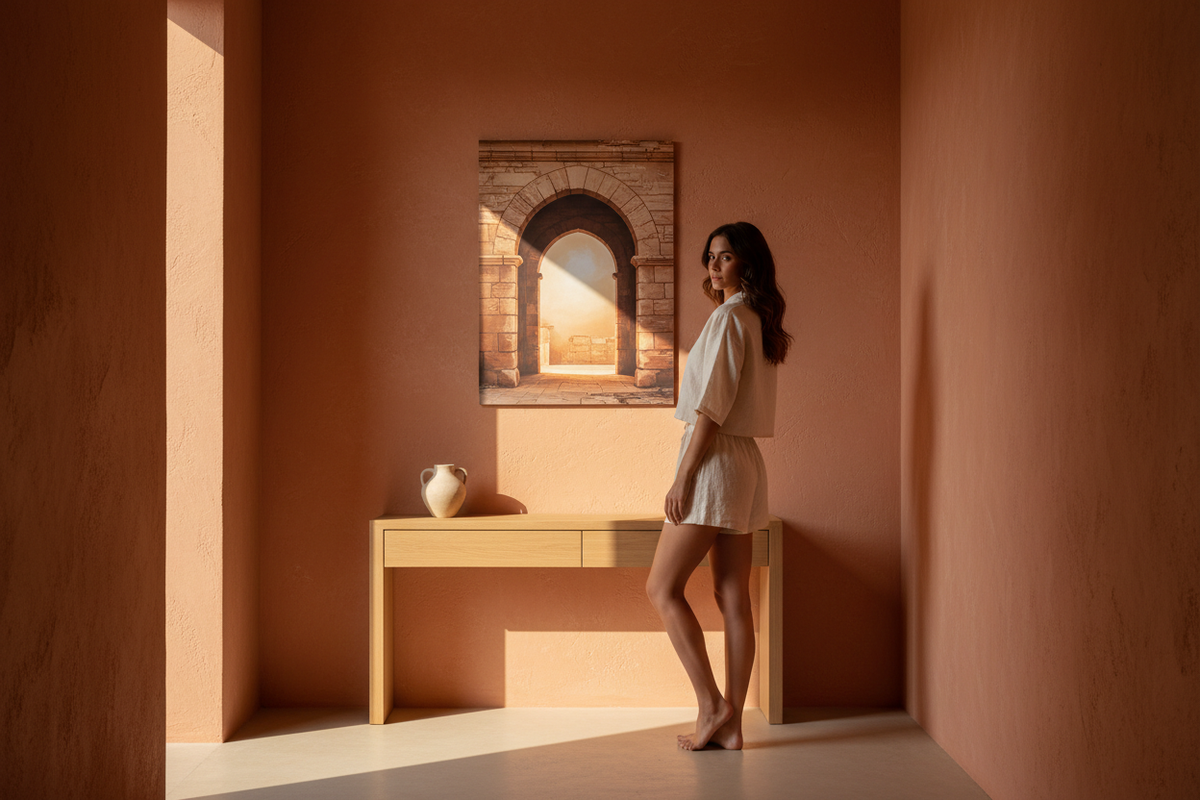
Terracotta hallway: how to decorate it without darkening it
Reading time: 6 min
Terracotta in a hallway is the riskiest bet in the house. A hallway rarely has a window, is often less than 120 cm wide, and a warm saturated colour does there exactly what you fear: it closes the space in. And yet it is also the room where terracotta gives its best result when it is well accompanied — because a hallway is not a place where you stay, it is a place you cross. It is allowed to be more intense than the living room.
What decides the outcome is not the shade of terracotta. It is what you put beside it, and at what height.
Why terracotta closes a hallway in, and how to avoid it
A warm colour advances visually. On both long walls of a narrow hallway it makes the walls feel closer. The reflex is then to lighten the shade — almost always the wrong answer: a washed-out terracotta loses its character without gaining any width.
Three solutions genuinely work, and none of them is about the shade:
- Paint one wall only — the end wall, or one of the two long ones. The eye keeps a light reference and the hallway stops closing in.
- Break the height — a terracotta dado over a third of the height, the rest in off-white or sand. The eye travels upwards.
- Bring in wood — the most effective solution, and the one people look for most. Light wood desaturates terracotta without dulling it.
Terracotta and wood: the pairing that saves a hallway
Terracotta is an earth colour: it calls for a material, not for another colour. Light wood — oak, ash, rattan — does that job better than any accompanying paint.
In practice, in a hallway: an oak console, a coat rack in raw wood, a solid oak frame around the print. The wood breaks up the mass of colour without introducing a third world.
What to avoid: dark reddish wood, cherry or mahogany, which blends into the terracotta and weighs everything down. Stay with light to mid-tone woods.

Le Couloir — a terracotta and sand perspective punctuated by wooden doors: exactly that pairing, in one image.
Terracotta and beige: the gentle version
If terracotta on its own feels too bold, pairing it with sand beige is the safest way out. Sand beige is a warm neutral: it does not cool the room down, it calms it.
The distribution that works in a hallway: sand beige on the long walls, terracotta on the end wall only. The end wall becomes a coloured vanishing point and the sides breathe. It is also the arrangement that shows a print on the end wall to best advantage.
To go further into the pairings: what colour goes with terracotta and sand beige walls, the warm neutral.
The wall niche, the architect's real solution
In a hallway, a niche cut into the partition does what no print can do: it creates depth where there is none. Painted terracotta in a beige hallway, or the reverse, it becomes the single resting point along the way.
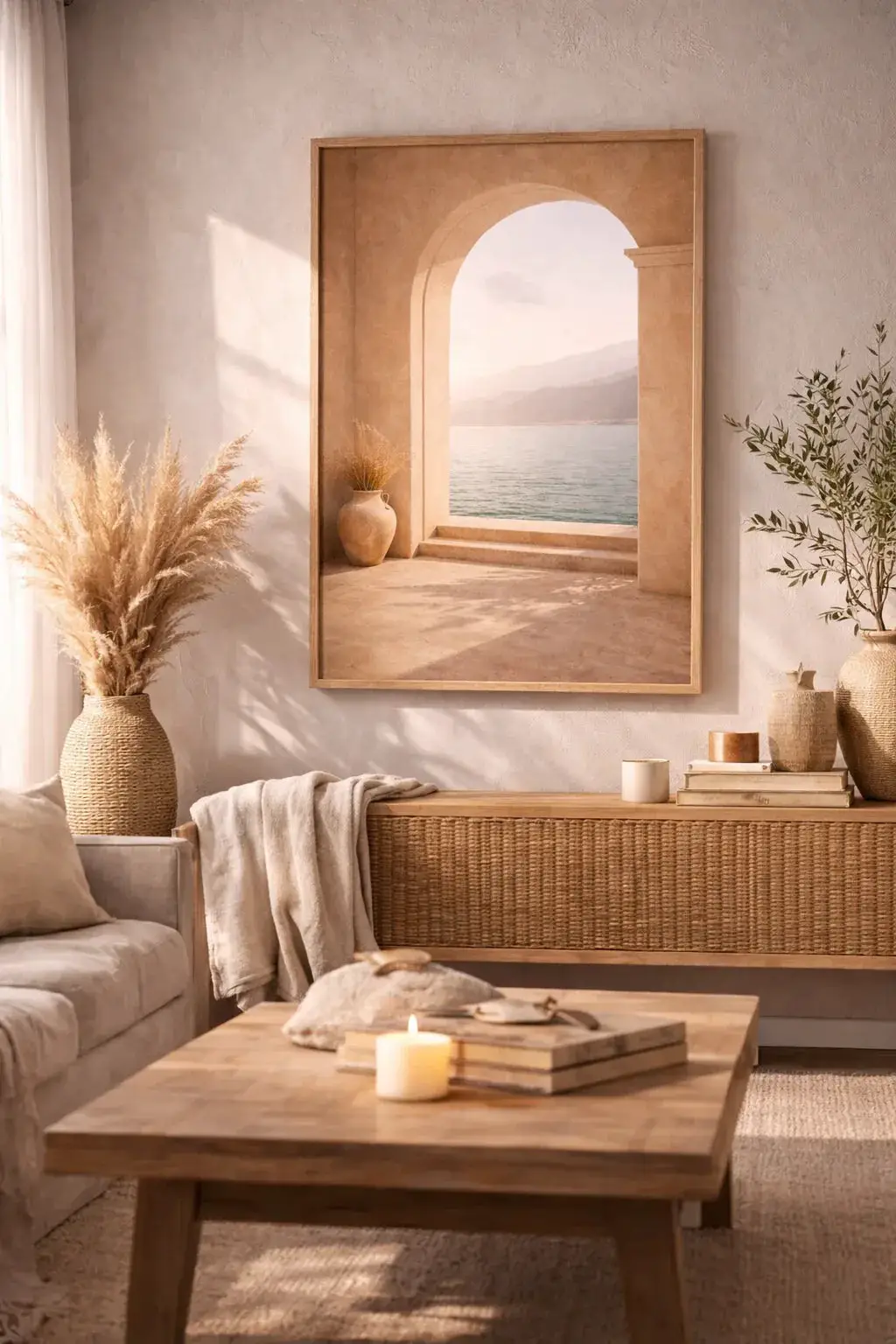
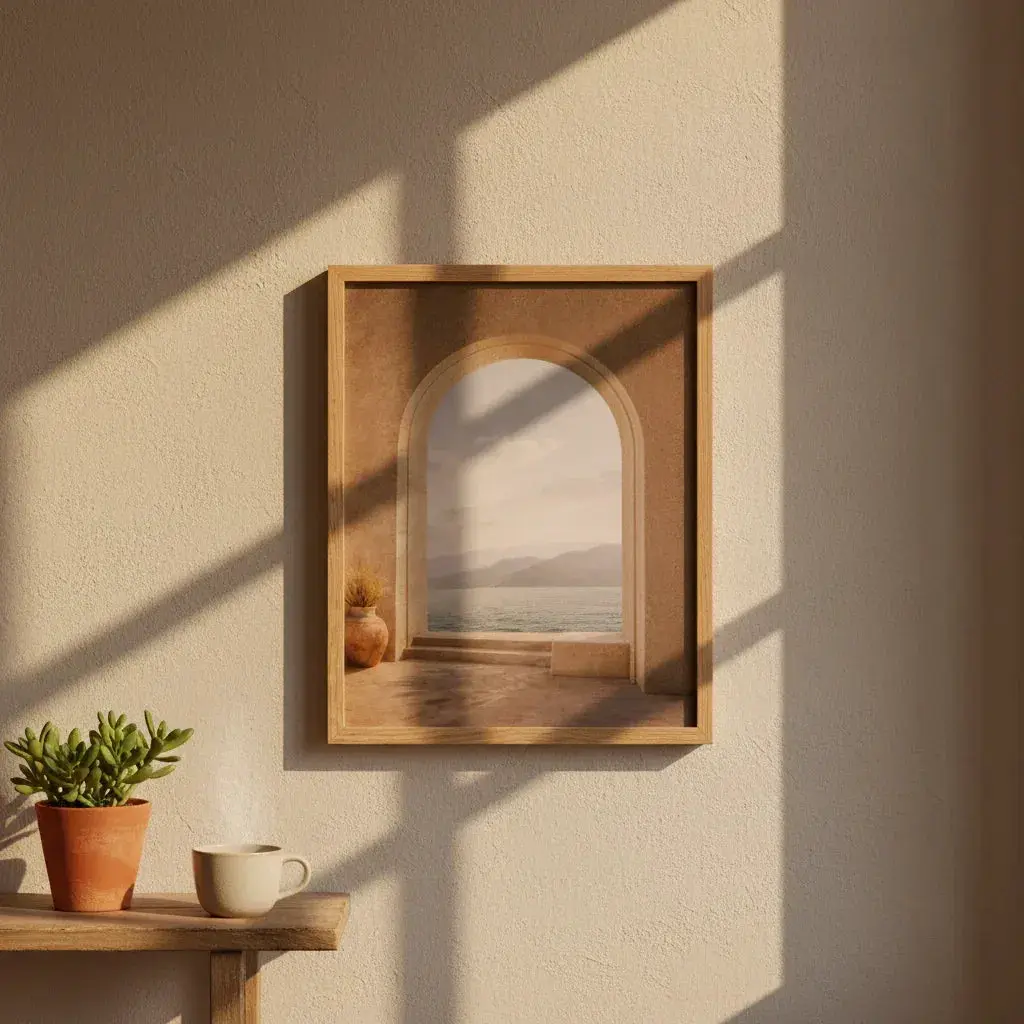
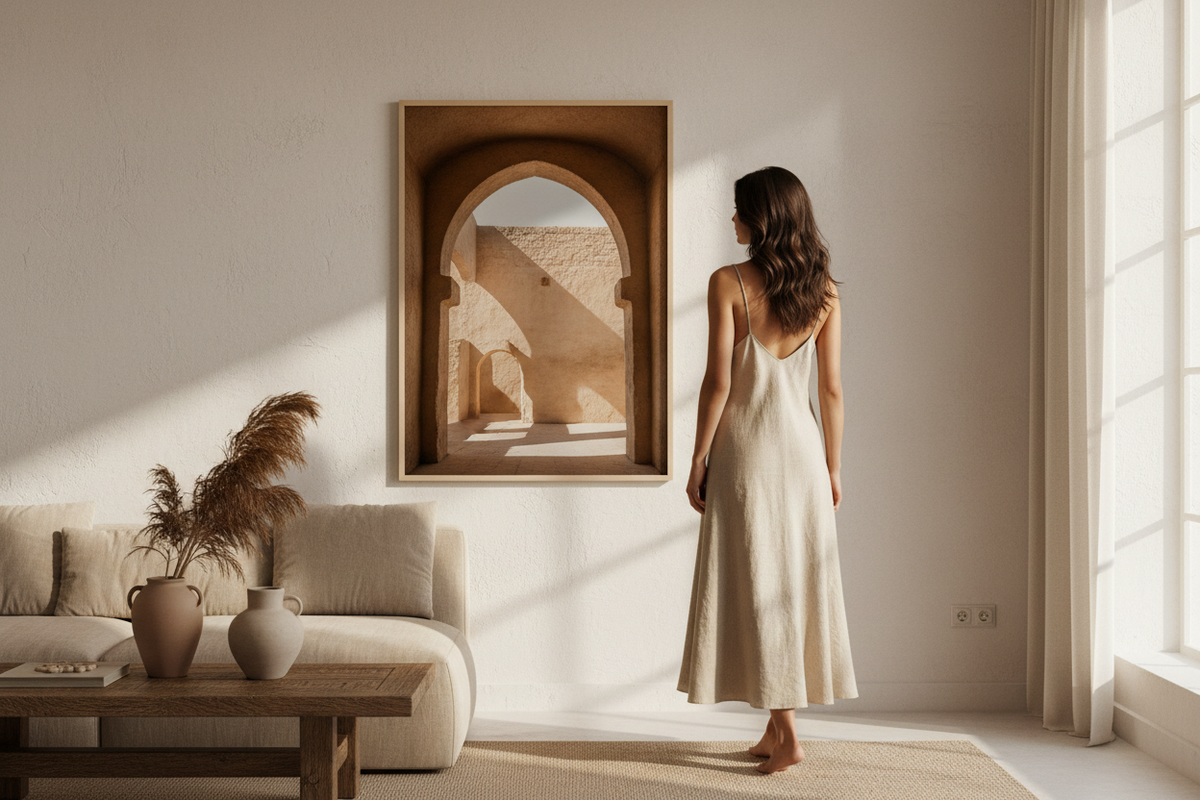
If you cannot cut into the wall — which is the case in most homes — an architectural print with an arch or a doorway produces a close effect: it simulates the opening. That is exactly why arches work so well in hallways. The detail is in the Mediterranean wall niche.

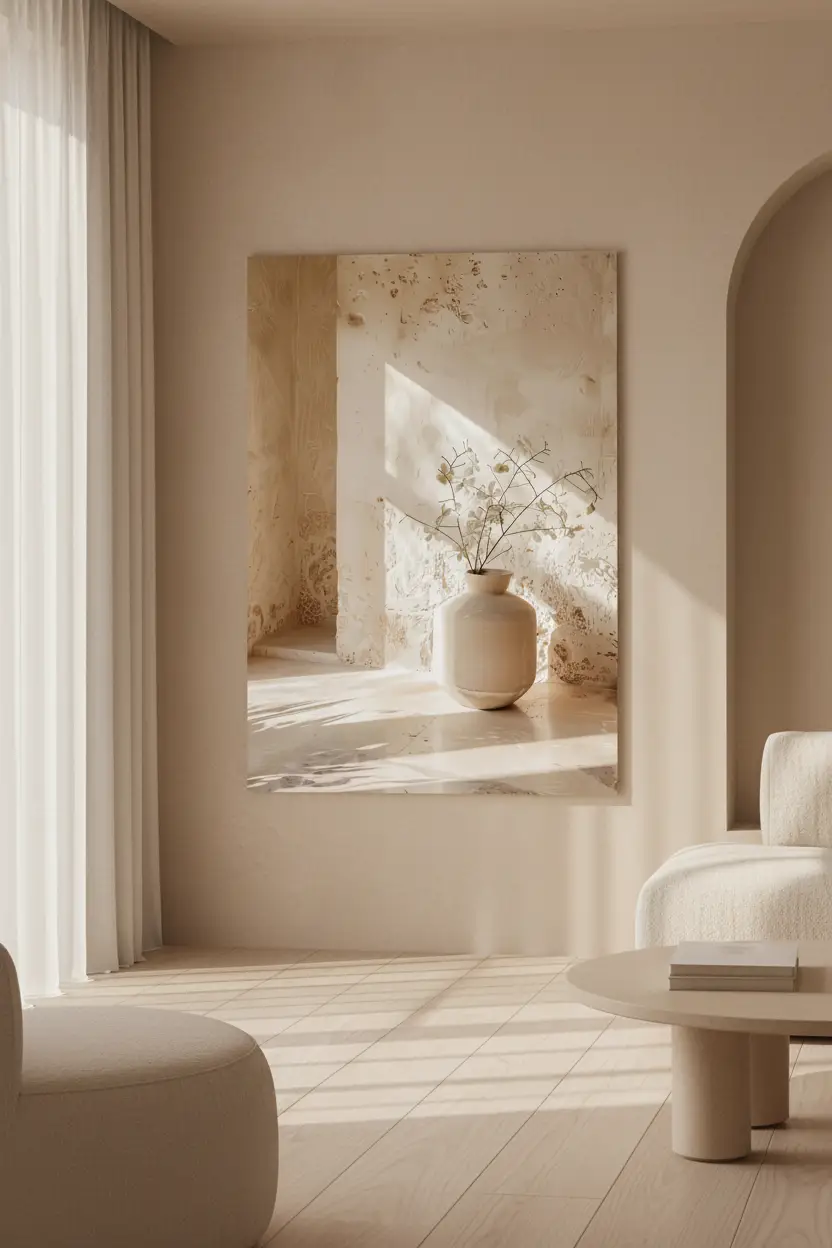
Le Passage Terracotta — a run of arches: the perspective extends the hallway instead of closing it.
Which print, at what height, in a hallway
A hallway is seen while walking and at an angle, never head-on from two metres. That changes three things.
- The size — stay with 30 × 40 cm or A2. A large format in a narrow hallway is never seen whole; it is endured.
- The height — centre at 150 cm rather than 145 cm. You walk, you do not sit.
- The subject — favour depth: arches, passageways, perspectives. A very tight close-up works badly in a space where you cannot step back.
Along a long hallway, a series of three prints of the same size, evenly spaced, paces the walk better than one large image. The full method is in choosing three prints that work together, and the hanging measurements in how to hang a print.
See the Affiche Terracotta collection →
Light, the real subject of a terracotta hallway
Terracotta under cold light turns a dirty brown. It is the most common mistake, and it has nothing to do with the paint.
In a hallway with no window, choose bulbs at 2,700 K, never above 3,000 K. A wall light aimed upwards beats a central ceiling fitting, which crushes the colour and flattens the wall. If you light a print, light it at a grazing angle, not head-on: 189 gsm matte paper takes oblique light beautifully and throws back no glare.

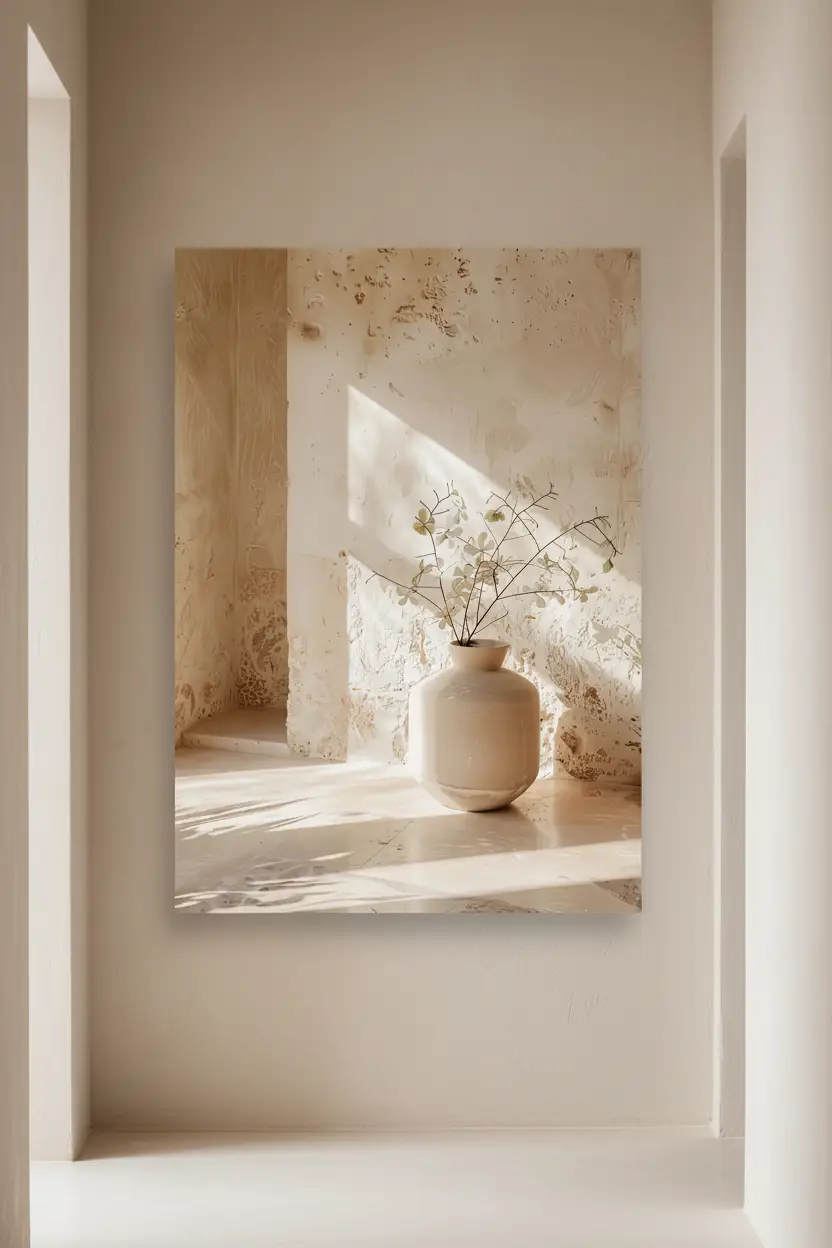
L'Arche et l'Escalier — a salmon-toned terracotta, softer, that holds up well under warm light.
The mistakes that close a hallway in
- Painting all four walls terracotta — the hallway becomes a tunnel. One wall, two at most.
- Hanging too low — in a hallway, a print hung too low cuts the perspective instead of following it.
- Mixing sizes — in a narrow space, irregularity reads as clutter. One size, one spacing.
- Adding a third colour — terracotta, a neutral, wood. That is complete. Sage green works, but in a room where you stop, not in a hallway.
- Lighting at 4,000 K — it kills the colour before you have hung anything at all.
FAQ — Terracotta hallway
What colour goes with terracotta in a hallway?
Sand beige and off-white first, with light wood as the material. Sage green works too, but it needs a little distance: save it for rooms where you stop. The full pairings are set out in what colour goes with terracotta.
Does terracotta really shrink a narrow hallway?
On the two long walls, yes. On the end wall alone, no: there it creates a vanishing point that lengthens the perspective. The rule is to place it perpendicular to the direction of travel.
What print size for a hallway?
30 × 40 cm or A2 (42 × 59.4 cm). Beyond that the print is never seen whole, since you cannot step back. The size comparison is in which poster size to choose.
Do terracotta and dark wood work together?
Poorly. Cherry and mahogany share terracotta's red undertones: the two blend together and the space becomes heavy. Stay with light oak, ash or rattan.
Does a print in a hallway need a frame?
It is recommended: a hallway is a passage, where people brush against the walls. Our solid oak frame protects the print and at the same time brings in the light wood that lifts the terracotta.
See also: Terracotta wall: which prints bring it to life — Decorating a narrow hallway — Terracotta and beige in the living room — Ochre, the colour of the sun



Leave a comment
This site is protected by hCaptcha and the hCaptcha Privacy Policy and Terms of Service apply.