

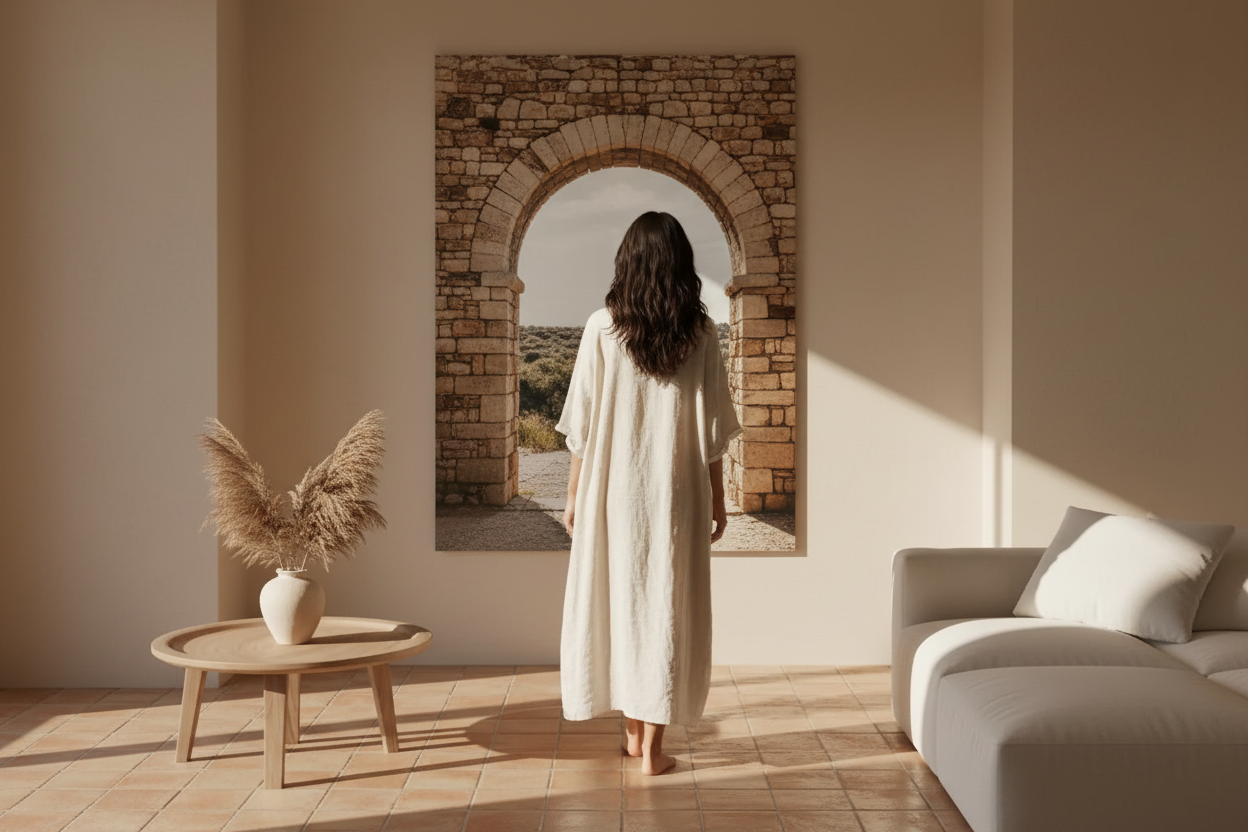
Seaside poster: bring the Mediterranean into your home, minimalist version
A beautifully placed poster that is poorly positioned loses half its effect. Too high, too low, off-center: these small errors are noticeable, even subconsciously. Here's how to hang a poster correctly, whether it's a single piece or an entire wall of frames. This guide covers everything: ideal height, fixings, gallery walls, and specific cases room by room.
Reading time: 7 min
1. The right height to hang a poster
The reference rule for galleries and museums: the center of the poster should be approximately 145–150 cm from the floor, which is average eye level. This is the most reliable benchmark, regardless of room size or ceiling height.
Above a piece of furniture (sofa, console, headboard), forget the floor as a reference: align yourself with the furniture instead. Leave 15 to 30 cm between the top of the furniture and the bottom of the frame — enough to visually connect the two elements without them touching.
- Above a sofa — 20 to 25 cm between the top of the backrest and the bottom of the poster.
- Above a headboard — 15 to 20 cm between the top of the headboard and the bottom of the poster.
- Above a console table — 15 to 20 cm between the top of the console and the bottom of the frame.
- Alone on a wall — center at 145–150 cm from the floor, horizontally centered.
- In a hallway — same rule, vertical format recommended.
To go further: living room poster guide, bedroom poster guide, entrance poster guide, office poster guide.

2. Preparing to hang
Good hanging requires preparation. Before fixing anything:
- Measure and mark — use a tape measure to find the horizontal center, mark with a pencil.
- Check for levelness — a spirit level or your smartphone's level app. A slight flaw is immediately visible.
- Test the placement — cut a paper template the size of the poster, attach it to the wall with masking tape. Step back, adjust before permanently fixing.
- Check the lighting — a poster facing a window can create annoying reflections if it's framed under glass.
3. With or without a frame
A poster alone, flush against the wall, gives a light and contemporary look — this is the Cassili approach par excellence. The solid oak framed version structures the poster and provides a gallery finish. In a bathroom, framing is recommended to protect the poster from humidity.
Avoid white passe-partout: it visually shrinks the poster and creates an artificial distance. To learn more: Framed poster or unframed poster: how to choose?

4. Fixing without damaging the wall
- Repositionable adhesive strips (e.g., Command Strips) — for posters and small frames up to 500g. Ideal for rentals.
- Adhesive hooks — for frames up to 2–3 kg. Check the supported weight.
- Picture rail or track — for an evolving gallery wall. Move posters without altering the wall.
- Classic fixing (wall plug + screw) — for heavy or large format A1 frames.
For a bare poster without a frame, adhesive strips at all four corners are sufficient up to 50×70 cm. For an A1, add two extra points in the middle of the long edges.

5. Creating a harmonious gallery wall
- Space regularly — 5 to 8 cm between each poster for a gallery effect.
- Arrange on the floor first — lay your posters on the floor, photograph the result before touching the wall.
- Mix formats but maintain coherence — same palette, same finish.
- Start from an anchor point — the central or largest poster, build around it.
- Align centers rather than edges for a harmonious look.
- Limit themes — two or three collections max: Architecture + Mineral, or Light + Vegetal.
Our gallery wall builder lets you compose your wall and see the result before you start. To go further: Creating an elegant gallery wall.

6. Specific cases room by room
- Living Room — the width of the composition should not exceed that of the sofa. A single large format (A1) or a triptych of 50×70 cm.
- Bedroom — proportional to the width of the bed. 160 cm bed: centered A1 or two 50×70 cm side by side.
- Entrance — a single well-chosen poster above a console table. Avoid overly busy compositions.
- Office — test the camera rendering if the poster is visible during video conferences.
- Bathroom — minimum 80 cm from water splashes, framed option recommended.
- Hallway — a series of posters of the same format aligned for a gallery effect.
Mistakes to avoid
- Hanging too high — the most frequent mistake. The poster becomes disconnected from the rest of the room.
- Too small a format — a single 30×40 poster gets lost on a large wall.
- Irregular spacing — creates an impression of disorder even with beautiful posters.
- Mixing frame styles — use only one type for immediate visual coherence.
When in doubt: a slightly larger poster, hung a little lower, almost always works better than the opposite.
FAQ
What is the correct height to hang a wall poster?
The center of the poster should be approximately 145–150 cm from the floor. Above a piece of furniture, leave 15 to 30 cm between the top of the furniture and the bottom of the poster to create a visual link without the two elements touching.
How to hang a poster without making holes?
Use repositionable adhesive strips (e.g., Command Strips) for lightweight posters, or adhesive hooks for heavier frames. These solutions can be removed without leaving a trace — ideal for rentals.
How to create a harmonious gallery wall?
First arrange on the floor, space each poster 5 to 8 cm apart, start with a central poster and build around it. Maintain the same palette and finish. Our configurator helps you visualize the result before you start.
Which wall poster for a large wall?
For a large wall, opt for an A1 format (59×84 cm) as a single piece, or a composition of 3 posters in 50×70 cm. A large format visually expands the room rather than overwhelming it.


Leave a comment
This site is protected by hCaptcha and the hCaptcha Privacy Policy and Terms of Service apply.