
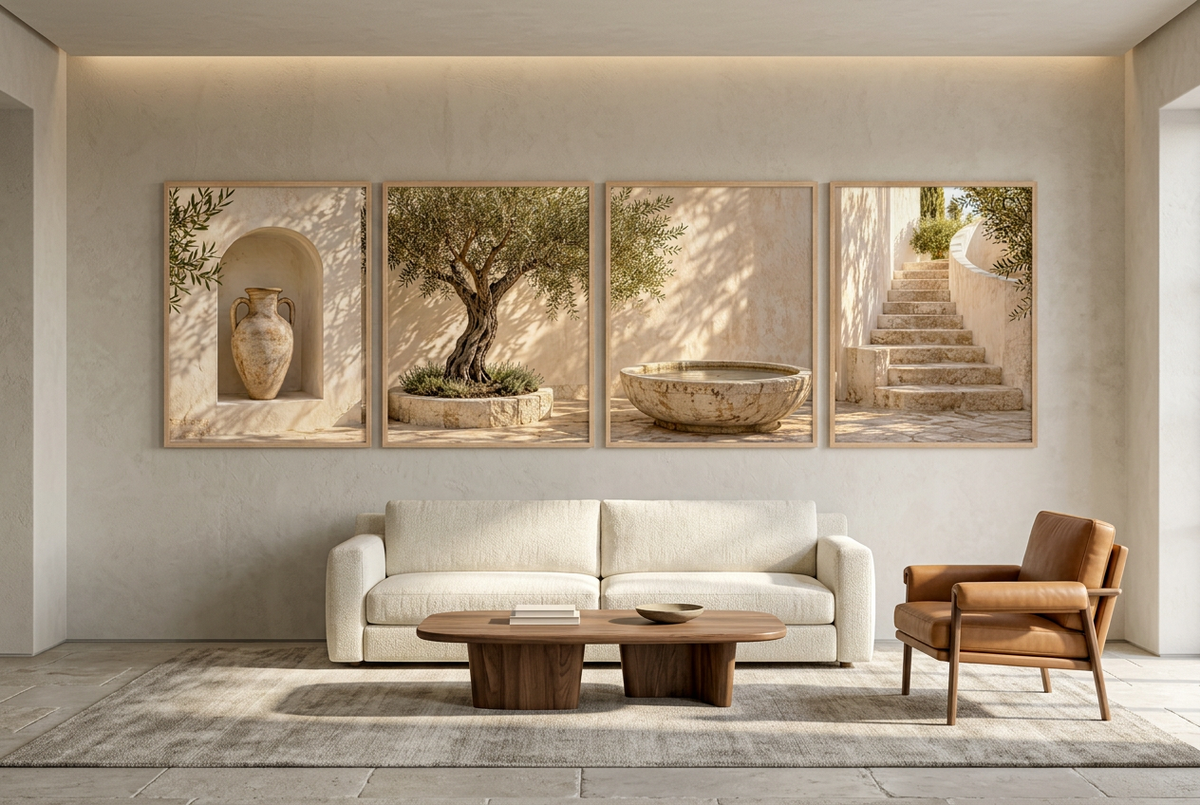
Wall quadriptych: when to choose four panels?
A three-meter wall above a corner sofa, a long hallway, a dining room wall: some walls are too big for a single poster, and still look half empty with a diptych or a triptych. That's where the quadriptych comes in: four panels that make up a single panorama. Here's how to tell whether it suits your wall, and which one to choose.
The width of the wall decides
Start from the width you want to fill: that of the furniture if there is any, otherwise that of the wall. Above furniture, the set should cover about two thirds of it; on a bare wall, keep a margin of at least 50 cm on each side. That gives you a few simple benchmarks:
- Up to 1.20 m to fill: a single poster, in 50 × 70 or A1.
- From 1.20 to 2 m: a diptych, two panels that tell one scene.
- From 2 to 2.60 m: a triptych, or a quadriptych in a small size.
- Over 2.60 m: the quadriptych, in 30 × 40 and up.
Our article Diptych, triptych or single poster covers the first three cases in detail. The quadriptych takes over where a triptych is no longer enough: the smallest is already 1 m wide in 21 × 30, the 30 × 40 measures 1.38 m, the A2 1.86 m and the 50 × 70 2.18 m, gaps included.
Why four panels rather than three large ones?
To cover the same width, a triptych has to grow taller too: three 70 × 100 panels are 2.26 m wide, but also one meter high. Four 50 × 70 panels cover almost the same width, 2.18 m, and are 30 cm lower. On a low wall, above a sofa or under a sloping ceiling, this elongated proportion makes all the difference: the set underlines the furniture instead of overpowering it.
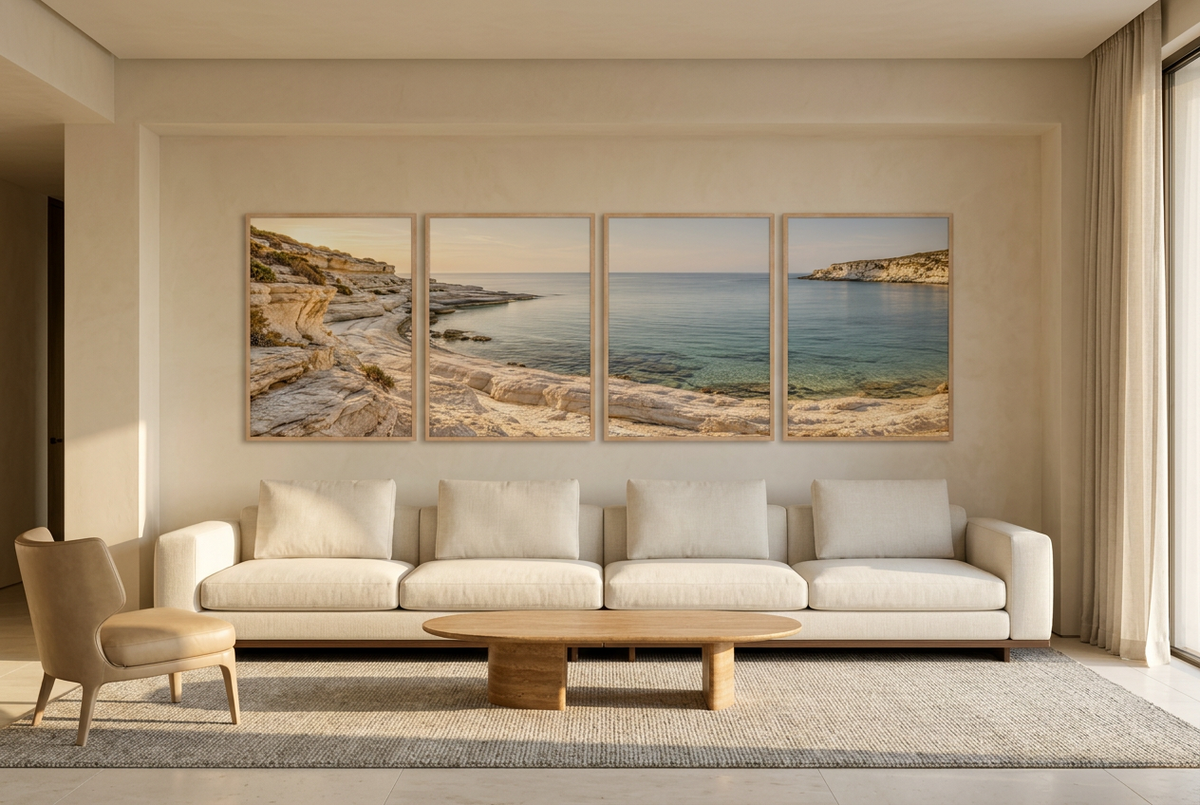
Four panels also tell a longer story. Our quadriptychs are panoramas: you follow a patio from the niche to the staircase, a cove from the shore all the way to the point. The eye travels along the wall from left to right, as if through a very wide window.
The walls made for a quadriptych
- The corner sofa or large sofa. At 2.40 to 3 m long, it calls for a set 1.60 to 2 m wide: the 30 × 40 or A2 quadriptych.
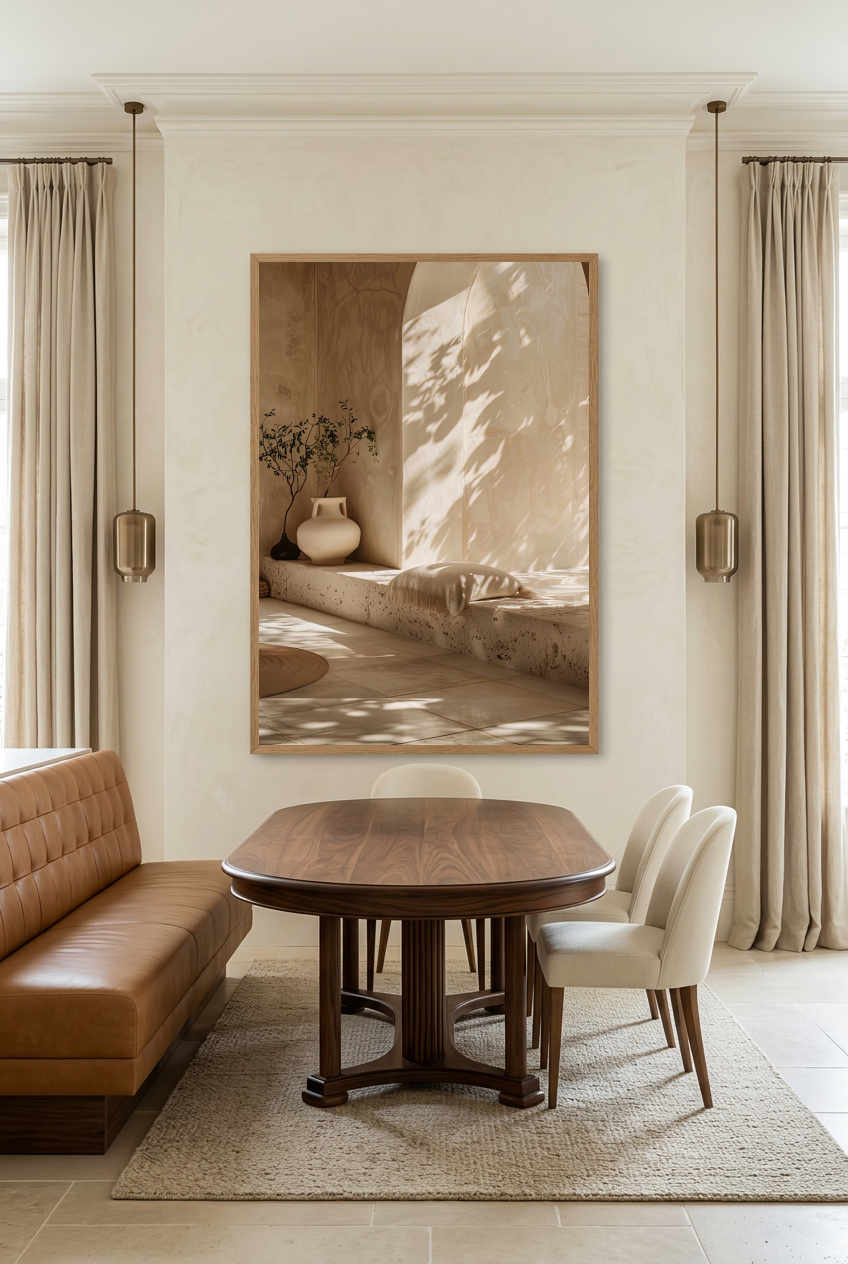
- The long dining room sideboard. A 2 m sideboard pairs with the 30 × 40, centered on the furniture, with the bottom of the panels 20-25 cm above the top.
- The hallway and entrance. A long, narrow wall is best read as you walk past: a panorama of sea or dry-stone terraces gives it depth.
- The king-size headboard. Above a 180 or 200 cm bed, the 21 × 30 or 30 × 40 fits the width without overwhelming the headboard.
- The large bare wall. In a living room or a double-height space, the large A1, 61 × 91 and 70 × 100 sizes create a focal point 2.5 to 3 m wide.
A row or a square?
The row is the intended layout: all four panels side by side, in order from 1 to 4, with the same 5 to 8 cm gap. That's how the horizon runs from one edge to the other. On a narrow wall, between two windows for example, you can also hang them in a square, two above two: the set becomes almost square, but the panorama reads in two lines and the continuity breaks in the middle. Keep it for walls where a row won't fit.
Mistakes to avoid
- Going too small. A 21 × 30 quadriptych above a 3 m sofa looks like it's floating. If you're torn between two sizes, go for the larger one.
- Mixing up the order. The panels are numbered: swap them and the landscape breaks apart.
- Uneven gaps. A one-centimeter difference between two gaps shows across four panels. Pencil in your marks before drilling.
- Hanging too high. The center of the set goes 145-150 cm from the floor; above furniture, leave 20 to 25 cm between its top and the bottom of the panels.
All the sizes, their real width and the step-by-step hanging method are brought together in our wall quadriptych guide. To see all twelve panoramas, from the limewashed courtyard to the shoreline dunes, read 12 Mediterranean wall quadriptychs.




Leave a comment
This site is protected by hCaptcha and the hCaptcha Privacy Policy and Terms of Service apply.